
Here I am.
I opened the book with the tip of my finger stained by a golden dust that did not come from the paper but from an older combustion.
And as soon as it touched my skin I felt a dry smell of resin, copper, and an already extinguished lamp, the kind left behind by enclosures where no one prays anymore, but I know that something listens.
The page was breathing.
Under the slanting light, a radiant cloud began to rise from the center of the sign, like a living substance wavering between smoke and revelation.
And from that burning whiteness the Tetragrammaton emerged with severity, with purity.
It did not speak the motionless name that theology keeps shut away in glass cases of damned obedience.
It spoke something else, a phrase with an edge.
I will be what I decide to be.
And that will pierced the pit of my stomach as though creation had never truly ended and every creature were only a syllable still warm on the tongue of the Word.
Then I understood that I was not reading a treatise but hearing a command.
The ancient insurrection of the divine against every fixed form, the flame, the intelligence.
I saw the eight-pointed star turning without turning, suspended in a depth that encompassed both sky and earth.
At its center the Solomonic hexagram held the word Word with a nuptial gravity.
As though every thought had been conceived there before learning to tremble.
Each ray burned at a different temperature and carried a music of metal, of blood, of seed ground between invisible stones.
Blessing descended like oil upon the forehead.
Sensation opened a wound of perfume.
Strength was a red-hot iron throbbing in the palm.
Discernment had the cutting transparency of crystal.
Order sounded like gearwheels beneath silence.
Wisdom smelled of damp parchment and a storm held back.
Cohesion bound the scattered with a mineral patience.
Fermentation raised its sour and fertile breath from the mud where power learns to rot in order to become fruit.
Honor, Glory, Power, and Riches did not shine with the vulgarity of triumph.
They shone with the dangerous majesty of that which can corrupt or sanctify depending on the mouth that invokes it.
At the ends of each ray, planetary and zodiacal signs flashed.
Channels through which the will of the Word falls upon matter and compels it to remember its obedience.
Here I am, for I traced that fierce diagram with my fingers, and for an instant I heard how God spoke from the burning center of every thing, while the cosmos, blind and magnificent, bent down to obey.The voice is sustained in a first person of visionary temper and severe control, more invocation than confession.
The dominant semantic fields are those of combustion.
Sacred writing.
Celestial mechanics and ritual matter, with tactile and olfactory images that thicken the occult atmosphere.
The piece works through latent anaphora.
Ascending enumeration and the personification of the symbol in order to turn the hermetic system into embodied experience.
The rhythm seeks swell and concentration, with long periods that hypnotize and an emotion of arduous revelation, never complacent.
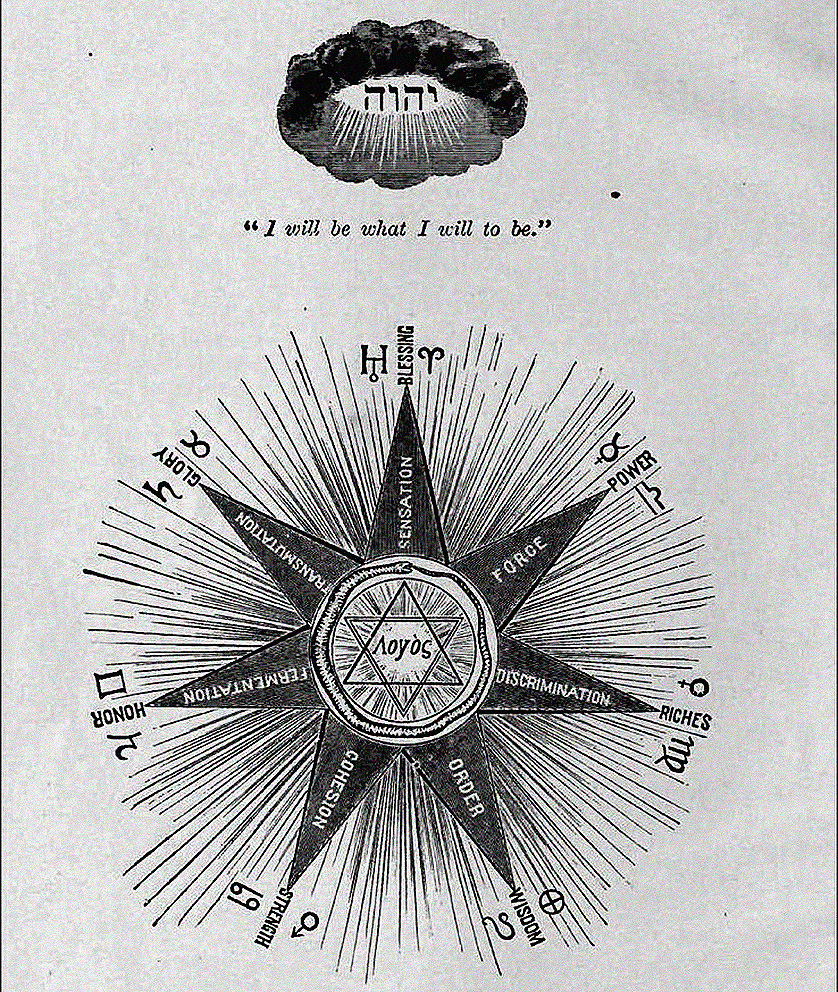
The so-called Diagram No. 1 belongs to The Light of Egypt, a hermetic work published by Thomas H. Burgoyne in 1889 as a doctrinal condensation of the teachings attributed to the Hermetic Brotherhood of Luxor, an order founded in London in 1884 by Burgoyne himself and Peter Davidson, under the influence of the elusive Max Theon. At the top of the diagram appears the Tetragrammaton, rising from a luminous cloud, accompanied by a translation that Burgoyne chooses with very precise intent: I will be what I decide to be. What is at stake here is not an immobile god, shut within the rigidity of traditional theology, but a volitional power that affirms itself in a continuous act of self-definition. Lower down, an eight-pointed star articulates the entire symbolic structure. At its core, the Solomonic hexagram guards the word Word, understood as the governing principle, prior in the hermetic vision both to the birth of the world and to the emergence of thought. Around this center are distributed the different qualities of divine manifestation “Blessing, Sensation, Strength, Discernment, Order, Wisdom, Cohesion, Fermentation, Honor, Glory, Power, and Riches,” while at the ends of the rays are placed the corresponding zodiacal and planetary signs, since Burgoyne does not regard the planets as mere distant bodies, but as active mediations through which the Word imprints its design upon substance. The whole ensemble thus functions as an image of the sacred mechanics of the universe, the divine Name as origin, the Word as impulse, and the entire cosmos responding to that primordial utterance.
 antjedieckmann.com